Mental Health Resources — A Complete Guide to Finding Help
You are not alone if you have been searching for mental health resources that actually fit your needs. Millions of people face emotional challenges every year, and knowing where to turn can feel overwhelming. Whether you are looking for free support, professional guidance, or online tools, the right resources can make a real difference. This guide walks you through the most trusted mental health resources available today. You will find crisis hotlines, national organizations, free options, and practical self-care steps. To begin exploring your emotional well-being on your own terms, consider trying our depression test as a private first step.
What Are Mental Health Resources and Why Do They Matter?
Mental health resources are services, tools, organizations, and support systems designed to help people understand, manage, and improve their emotional well-being. They range from crisis hotlines and therapy services to free apps and peer support communities.
These resources matter because mental health challenges affect nearly one in five adults each year. However, many people delay seeking help due to cost concerns, stigma, or simply not knowing where to start. The right resource can bridge that gap — offering a safe space to reflect, learn, and take meaningful next steps.
Understanding what is available puts you in a stronger position. When you know your options, choosing the right path becomes far less intimidating.
Trusted Free Mental Health Resources You Can Access Today
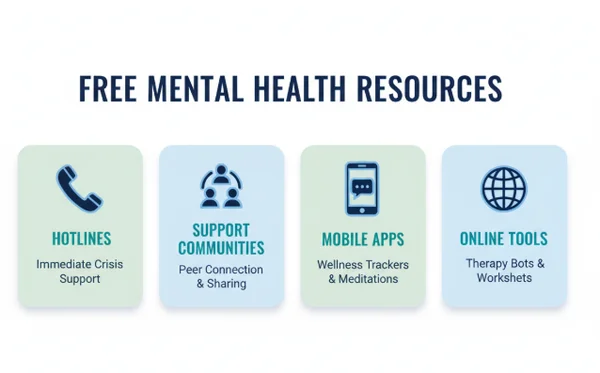
Cost should never be a barrier to emotional support. Several well-established organizations offer completely free mental health resources.
Crisis Hotlines and Immediate Support
If you or someone you know is in crisis, these services provide immediate help around the clock:
- 988 Suicide & Crisis Lifeline — Call or text 988 for free, confidential support 24/7
- Crisis Text Line — Text HOME to 741741 to connect with a trained crisis counselor
- SAMHSA National Helpline — Call 1-800-662-4357 for treatment referrals and information
- Veterans Crisis Line — Dial 988 then press 1, or text 838255
National Organizations Offering Free Support
These organizations provide education, peer support groups, and resource directories at no cost:
- NAMI (National Alliance on Mental Illness) — peer-led support groups and educational programs
- Mental Health America — free screening tools, community resources, and advocacy
- ADAA (Anxiety and Depression Association of America) — free peer-to-peer online communities
- NIMH (National Institute of Mental Health) — research-backed information and resources
Free Online Tools and Apps
Several apps provide self-help features without a subscription:
- Moodfit — mood tracking with CBT-based exercises
- Breathe2Relax — guided breathing for stress management
- MindShift CBT — evidence-based strategies for anxiety relief
- PTSD Coach — tools for managing post-traumatic stress symptoms
Each of these free mental health resources offers a different type of support. Consider which one matches your current needs most closely.
What Types of Mental Health Professionals Can Help?
Navigating mental health care starts with understanding the different types of professionals available. Each one brings a distinct skill set to the table.
Therapists and Counselors
Licensed therapists, counselors, and clinical social workers provide talk therapy. They help you work through emotional challenges using evidence-based approaches like Cognitive Behavioral Therapy (CBT) or Dialectical Behavior Therapy (DBT). These professionals hold master's-level degrees and are trained in a wide range of therapeutic techniques.
Psychologists
Psychologists hold doctoral degrees and can conduct psychological assessments. They offer individual and group therapy, and they specialize in understanding behavioral patterns and emotional functioning.
Psychiatrists
Psychiatrists are medical doctors who can prescribe medication for mental health conditions. Some also provide therapy, though many focus primarily on medication management. If you think medication might be part of your care plan, a psychiatrist is the right starting point.
Peer Support Specialists
Peer supporters are people with lived experience of mental health challenges. They offer empathy, practical guidance, and community connection — often through organizations like NAMI or DBSA. While they are not licensed clinicians, their personal understanding can be deeply reassuring.
Understanding these roles helps you decide which type of support matches your situation best.
How to Find Mental Health Resources Near You
Searching for mental health resources near me is one of the most common queries people have. Here are practical ways to locate local support.
Start With Your Primary Care Doctor
Your doctor can perform an initial screening, offer referrals, and help you understand whether therapy, medication, or both might be beneficial. This is often the simplest first step.
Use Online Provider Directories
Several tools make it easy to search for providers in your area:
- SAMHSA's Find Support tool — search for local mental health and substance use treatment
- Psychology Today's Therapist Finder — filter by location, specialty, and insurance
- NAMI's local affiliate directory — connect with community-based programs near you
Check Your Insurance or Employee Benefits
Many insurance plans cover mental health services. Contact your provider to request a list of in-network therapists. Additionally, Employee Assistance Programs (EAPs) through your workplace often include free short-term counseling sessions.
Community and Sliding-Scale Options
If you are uninsured or underinsured, community mental health centers frequently offer services on a sliding-scale basis. Universities with training clinics may also provide low-cost therapy with supervised graduate students.
Finding the right fit takes time. However, starting with even one of these steps brings you closer to meaningful support.
What Mental Health Resources Are Available Online?
Online mental health resources have expanded significantly, making support more accessible than ever.
Teletherapy Platforms
Services like BetterHelp and Talkspace offer licensed therapy through video, phone, and text. While these are paid platforms, they often cost less than traditional in-office sessions and offer financial assistance for qualifying individuals.
Peer Support Communities
Free online communities provide a space to connect with others who understand your experience:
- 7 Cups — free text-based chats with trained listeners
- DBSA Online Support Groups — peer-led sessions for depression and bipolar disorder
- 18percent — anonymous peer-to-peer mental health community
Self-Guided Programs
Some platforms offer structured programs you can complete at your own pace. These often include interactive tools, worksheets, and psychoeducation modules designed to help you develop coping strategies.
Online resources for mental health work best when combined with professional guidance where possible. They offer a strong starting point, especially if in-person options feel out of reach right now.
Mental Health Resources for Specific Groups
Not every resource is a one-size-fits-all solution. Some populations have unique needs that specialized resources address more effectively.
Mental Health Resources for Teens
Adolescents face distinct challenges — academic pressure, social dynamics, and identity development. Helpful resources include:
- The JED Foundation — emotional health programs for teens and young adults
- Teen Line — peer support via phone and text, run by trained teens
- Child Mind Institute — free resources on youth mental health conditions
Parents and caregivers can also benefit from these resources by gaining insight into what their teens may be experiencing.
Mental Health Resources for Men
Men often encounter unique barriers to seeking help, including social expectations around emotional expression. Specialized resources include:
- Heads Up Guys — practical tips and resources specifically for men experiencing depression
- Man Therapy — an approachable platform addressing men's mental health with practical tools
- Movember Foundation — mental health programs and community support for men
These men's mental health resources acknowledge that asking for help is a strength — not a weakness.
Resources for Specific Conditions
If you are dealing with a specific condition, targeted organizations can offer more focused support:
- ADAA — anxiety and depression
- DBSA — depression and bipolar disorder
- International OCD Foundation — obsessive-compulsive disorder
- NEDA — eating disorders
How to Know Which Mental Health Resource Fits Your Needs
With so many options available, choosing the right resource can feel daunting. This quick self-reflection can help you narrow things down.
Ask Yourself These Questions
- Am I in immediate distress? → Start with a crisis hotline (988 or Crisis Text Line)
- Do I need ongoing professional support? → Look into therapy with a licensed provider
- Am I looking for peer connection? → Explore support groups through NAMI or DBSA
- Do I prefer self-guided learning? → Try a free app or online psychoeducation program
- Am I unsure where I stand emotionally? → A self-reflection screening tool can help clarify your next step
Sometimes the most helpful first move is simply checking in with yourself. A brief, private self-assessment can organize your thoughts and highlight areas that deserve attention. If you would like a structured way to reflect on your emotional well-being, you might find it helpful to explore our depression screening tool — it is free, confidential, and designed for self-understanding rather than diagnosis.
This tool is not a diagnostic instrument. It is meant to support self-reflection and help you decide whether professional support might be a good next step.
Everyday Steps to Support Your Mental Health
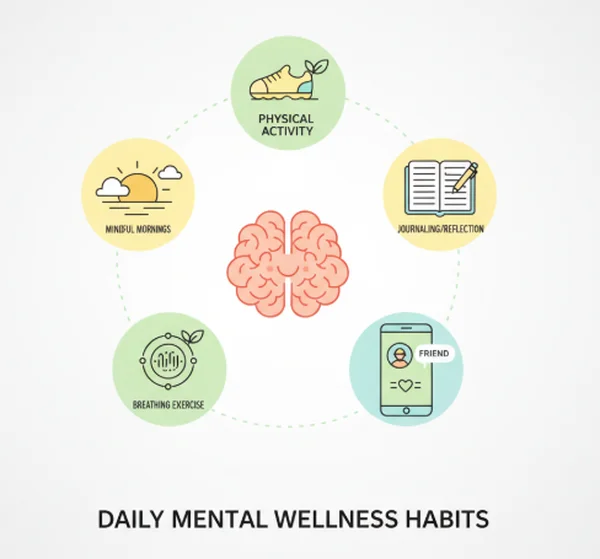
Professional resources are essential, but daily habits also play a powerful role in emotional well-being. These small actions can build resilience over time.
Build a Simple Daily Routine
- Move your body — even a 10-minute walk can improve mood
- Practice mindful breathing — three slow breaths can reduce stress in the moment
- Limit news and social media — set specific times for consumption to avoid overwhelm
- Stay connected — reach out to one person daily, even with a brief text
- Write it down — journaling for five minutes can help you process emotions
Know When Daily Practices Are Not Enough
Self-care supports your well-being, but it has limits. If you notice persistent low mood, difficulty functioning at work or school, withdrawal from relationships, or thoughts of self-harm, these are signals to reach out to a professional.
Seeking help is not a sign of failure. It is one of the most courageous steps you can take.
When Should You Seek Professional Mental Health Help?
It can be hard to tell whether what you are feeling is a passing rough patch or something that needs professional attention. Here are some signs that indicate it may be time to reach out.
Signs Professional Support May Help
- You feel persistently sad, anxious, or empty for more than two weeks
- Everyday tasks like eating, sleeping, or working feel significantly harder
- You have lost interest in activities you used to enjoy
- You find yourself withdrawing from friends and family
- You are using substances to cope with emotional pain
- You have thoughts of harming yourself or others
If any of these feel familiar, you do not need to have all the answers before seeking help. Even one conversation with a professional can bring clarity.
How to Take the First Step
Start by calling your primary care doctor, contacting your insurance provider for referrals, or reaching out to a crisis line. Many mental health support resources also offer initial consultations at no cost.
Remember — asking for help is a sign of strength, and support is available at every stage of the journey.
A Gentle Reminder Before You Go
Mental health resources exist to meet you wherever you are. Whether you need immediate crisis support, ongoing therapy, or a quiet moment of self-reflection, there is something out there designed to help. The most important step is the one you take next.
If you are looking for a simple, private way to check in with your emotional well-being, our free depression self-assessment offers a safe starting point — no commitment, no judgment, just a clearer picture of where you stand right now.
This content is for educational and informational purposes only. It does not constitute medical advice, diagnosis, or treatment. If you are experiencing a mental health crisis, please contact the 988 Suicide & Crisis Lifeline or call your local emergency services immediately.
Frequently Asked Questions
What are the best free mental health resources?
The 988 Suicide & Crisis Lifeline, NAMI support groups, Mental Health America screening tools, and SAMHSA's helpline are among the most trusted free mental health resources available today. Free apps like Moodfit and MindShift CBT also provide evidence-based self-help at no cost.
How do I find mental health resources near me?
Start by asking your primary care doctor for referrals. You can also use SAMHSA's Find Support tool, Psychology Today's therapist finder, or contact your local NAMI affiliate to connect with community-based mental health programs.
What mental health resources are available for teens?
The JED Foundation, Teen Line, and the Child Mind Institute offer programs and support specifically designed for adolescents. Many schools also provide access to counselors and mental health services at no additional cost.
How can I access mental health care without insurance?
Community mental health centers often provide services on a sliding-scale basis. University training clinics offer low-cost therapy, and SAMHSA's helpline can connect you with free or reduced-cost treatment options in your area.
What is the difference between a therapist and a psychiatrist?
Therapists provide talk therapy using evidence-based methods and hold master's or doctoral degrees. Psychiatrists are medical doctors who can prescribe medication. Both can work together to provide comprehensive mental health care.
How can I help someone who is struggling with mental health?
Listen without judgment, validate their feelings, and gently encourage them to explore professional support. You can share specific resources like NAMI or the 988 Lifeline. Avoid giving advice that sounds prescriptive — sometimes being present is the most helpful thing you can do.