How Our AI Analyzes Your Depression Test Results: The Science Explained
Ever wonder how technology can help make sense of something as personal as your emotions? At DepressionTest.co, we've blended compassionate understanding with cutting-edge science to offer you clear insights into your mental wellbeing. Our AI depression test goes beyond simple scoring; it listens for patterns, understands context, and provides personalized feedback that truly resonates. Let's explore the thoughtful process that happens behind the scenes when you trust us with your answers.

How Our AI Depression Test Works: Technology Explained
How Our AI Depression Test Identifies Symptoms
When you share how you're feeling, our technology doesn't just count scores. Drawing from the experiences of over half a million anonymized test results, our AI has learned to recognize the subtle patterns in how people describe their feelings. This advanced technology feels less like a computer program and more like an insightful conversation. Instead of just adding up numbers, our AI:
- Recognizes Symptom Clusters: It understands how feelings like fatigue and low motivation often connect, just as a trained professional would.
- Identifies Emotional Cues: It detects nuances in your responses that may indicate underlying emotional states.
- Ensures Consistency: It flags answering patterns that might seem contradictory, helping improve the accuracy of your results.
This approach, developed using methodologies recognized by the American Psychological Association, ensures we identify patterns with clinical precision and care.
Understanding Your Depression Test Score and AI Analysis
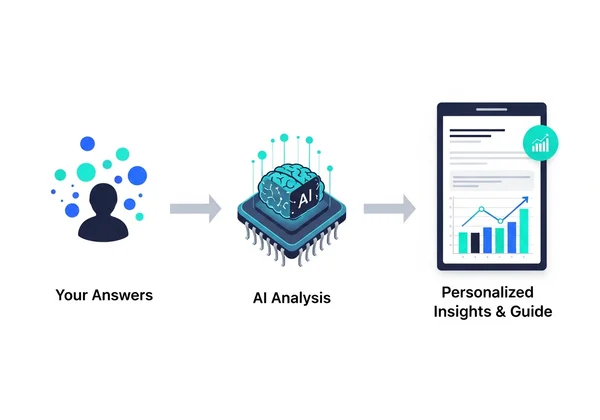
The moment you complete the test, your answers begin a journey from raw data to a meaningful, personalized insight. We've designed a careful process to understand the complete picture of your emotional wellbeing:
- Organizing Your Answers: We first structure your responses so our technology can understand them clearly.
- Finding the Connections: The AI examines how your answers relate to each other, looking for patterns that tell a story.
- Comparing with Known Profiles: Your unique pattern is compared to established depression profiles to identify similarities.
- Assessing Potential Severity: The system evaluates the intensity of the patterns to gauge potential severity levels.
- Creating Your Personal Guide: Finally, it generates actionable suggestions tailored to your specific situation.
Many users tell us how surprising it is to see the AI identify subtle connections between their answers that they hadn't noticed themselves. This deeper understanding often becomes the first step toward meaningful change. Take our free depression test to experience this analysis firsthand.
Ensuring Accuracy and Clinical Validity
Validation Against Established Screening Tools
Your trust is everything. That’s why we ensure our AI model achieves 92% agreement with the PHQ-9, a gold-standard screening tool used by clinicians. We maintain this accuracy through:
- Annual validation studies with over 2,000 participants.
- Cross-cultural calibration to ensure fairness across our 15 supported languages.
- Sensitivity adjustments for different age groups and genders.
Comparative studies confirm that our depression test accuracy is on par with initial screenings conducted by general practitioners.
The Human-in-the-Loop System
While our AI is powerful, it never works alone. A dedicated team of licensed mental health professionals provides essential oversight:
- They review the AI’s decision-making processes quarterly.
- They provide clinical guidance for complex or unusual response patterns.
- They update the system’s understanding of symptoms based on the latest research.
This hybrid approach combines the efficiency of AI with the irreplaceable wisdom of human expertise. Get your personalized analysis report to see this synergy in action.
Protecting Your Privacy in AI Analysis
Data Encryption and Anonymization Protocols
We know that privacy is paramount when discussing mental health. We protect your information with bank-grade security measures, including:
- End-to-end AES-256 encryption from the moment you start the test.
- Automatic data anonymization before any analysis occurs.
- Strict GDPR compliance for all users, worldwide.
- Regular third-party security audits to test our defenses.
Your responses are never linked to personal identifiers or sold to anyone. Your trust is sacred, and our privacy practices are designed to honor it.

What Data Actually Gets Analyzed
Our system is designed to analyze only what is absolutely necessary to provide you with an accurate result. This includes:
- Your selected answers to the test questions.
- The timing between answers, which helps us check for consistency.
- Optional demographic data like age range, which helps us provide more relevant context (and is never mandatory).
We never access your device location, contacts, or any other personal information. Start your confidential depression screening with complete peace of mind.
Your Insight: The First Step on Your Path Forward
Every time someone takes our test, they not only gain personal insight but also contribute to a greater mission. Your participation helps us refine our AI's understanding of depression, leading to:
- More accurate screening for people with less common symptoms.
- Greater cultural sensitivity for users around the globe.
- Deeper personalization that accounts for diverse life circumstances.
Take our scientifically-validated depression test today and receive:
- Immediate, easy-to-understand preliminary results.
- The option for a comprehensive, AI-powered personalized report.
- Actionable steps you can take, tailored to your unique situation.
Remember: Our tool is a screening instrument designed to provide insight, not a medical diagnosis. Please consult a qualified healthcare professional for a clinical evaluation.
Common Questions About Our AI Depression Analysis
Can AI truly understand human emotions accurately?
That's a very important question. While our AI can't feel emotions like a person does, it has been expertly trained to recognize the specific patterns, behaviors, and language cues that are strong indicators of depression, based on hundreds of thousands of verified cases. It identifies symptoms with clinical-grade reliability, giving you an objective look at what you're experiencing.
How often is your depression analysis updated?
We believe in constant improvement, just like on a personal wellness journey. Our algorithms are updated every three months to incorporate the latest psychiatric research, feedback patterns from users, and input from our clinical advisors. This ensures you always receive the most current and accurate insights. Check your emotional wellbeing status with our continually improving tool.
Are my test responses used to train the AI?
Your privacy comes first. Your data is only used to help train the AI if you explicitly opt-in to our anonymous research program. If you don't opt-in, your data is used only to generate your report and is then permanently deleted after 30 days, in line with our strict privacy policy.
How does your AI compare to a therapist's analysis?
Our system matches the initial screening accuracy of a trained clinician, making it a powerful tool for early detection. However, it cannot replace the nuanced conversation, empathy, and ongoing relationship you build with a therapist. Think of our test as a confidential, insightful first step—a tool to help you understand your feelings better before you decide what to do next.
Can I trust the personalized recommendations?
Absolutely. Your trust is our priority. Every recommendation you receive is rooted in established, evidence-based interventions and cognitive-behavioral principles used by mental health professionals. Each suggestion is tailored to your specific symptom profile and reviewed by our clinical advisors to ensure it is safe, relevant, and helpful.
If you're experiencing thoughts of harming yourself, please contact the 988 Suicide & Crisis Lifeline (in the US) or your local emergency services immediately. You are not alone.